


How do website owners choose which languages to offer? Which platforms are commonly used for multilingual websites, and where do language switchers typically appear?
To map multilingual website trends in 2026, ConveyThis analysed aggregated website configuration data from a sample of websites using its translation platform.
The findings reveal patterns in language preferences, translation configurations, website platforms, and language-switcher design.
This report explores those findings and what website owners can learn from them. No individual website is named, and every figure is an aggregate.
Why we care
We believe the web works better when people can read it in their own language.
A newcomer preparing for an exam should understand the questions. A small business should be able to welcome customers from across the border. A nonprofit should be able to explain its mission to everyone it serves, not only to people who read English.
Translation is how we help. Communication is the point.
That’s why ConveyThis has a Free plan that lets a small website go multilingual without paying anything, and why customers who grow with us on a paid plan get a team that answers their questions and fixes what needs fixing.
Now, the findings.
120 languages, and one clear favourite route
ConveyThis supports more than 200 languages, and the websites in our sample already translate into 120 of them, starting from 44 original languages.
One translation route stands far above the rest.
English to Spanish is used by almost twice as many websites as English to French, the second most common route. With hundreds of millions of speakers across two continents, Spanish is the most common first choice in our sample.
A little lower down, German to English, Spanish to English and French to English all make the top 10. Translation doesn’t only flow out of English.
English is the most frequently added language
A little more than half of the websites in our sample are written in English. The other 44% start in German, Spanish, French, Dutch, Italian, Japanese or dozens of other languages.
And the language they add most often is English, configured on 38% of websites, ahead of Spanish.
So a multilingual website isn’t only an English-language business reaching abroad. Very often it’s a Dutch shop, an Italian manufacturer or a Japanese studio making its content available in English.
These figures describe how websites are configured. They show which languages website owners choose to offer, not how many visitors read each language.
Who’s behind these websites?
All kinds of organisations. The websites in our sample include a surf school, an exam-preparation site for future citizens, a clinical research centre, an environmental nonprofit network, an industrial manufacturer, a removals company, a consultancy and many more.
They’re built with very different tools, too.
WordPress is the most common named platform, followed by Squarespace, Weebly and Wix, while Webflow, Shopify, Framer and other platforms together make up another slice. The largest share, though, is custom websites, built by hand, by an agency or with a framework. ConveyThis works with a plugin, an app or a short snippet of code, so the platform underneath doesn’t matter.
Most websites translate into one language
73% of websites translate into a single language. Going multilingual doesn’t have to be a big project: many website owners choose the one language their visitors need most and switch it on.
At the other end, about 2% of websites translate into ten or more languages, some of them including Somali, Hmong and Swahili alongside the more common choices.
Regional languages are part of the picture too. Nearly 1 in 5 websites in the sample that were added this year use a regional language, such as Spanish for the United States, Mexican Spanish, Canadian French, British English or Brazilian Portuguese. “Spanish” is good. “Spanish the way my customers speak it” is better.
The switcher personality test
Every multilingual website needs a way for visitors to change the language, and website owners have clear preferences.
Where does it go?
More than half of websites put the switcher in the bottom-right corner, the same corner many websites use for a chat button. The top-left corner, usually home to the logo, is left almost empty.
Flags or no flags?
The classic rectangle wins easily, and circles come second. About 1 in 10 websites skip flags entirely and show only the language name, a thoughtful choice when one language is spoken in many countries.
As for the switcher itself, almost 9 in 10 websites use the dropdown.
Glass is the early favourite
On 6 October we gave the switcher four new looks: Glass, Neon, Bubble and Auto. Website owners started switching them on in the very first days.
Glass leads. It’s frosted and translucent, so the website shows through, and it looks especially good over photos and colourful headers.
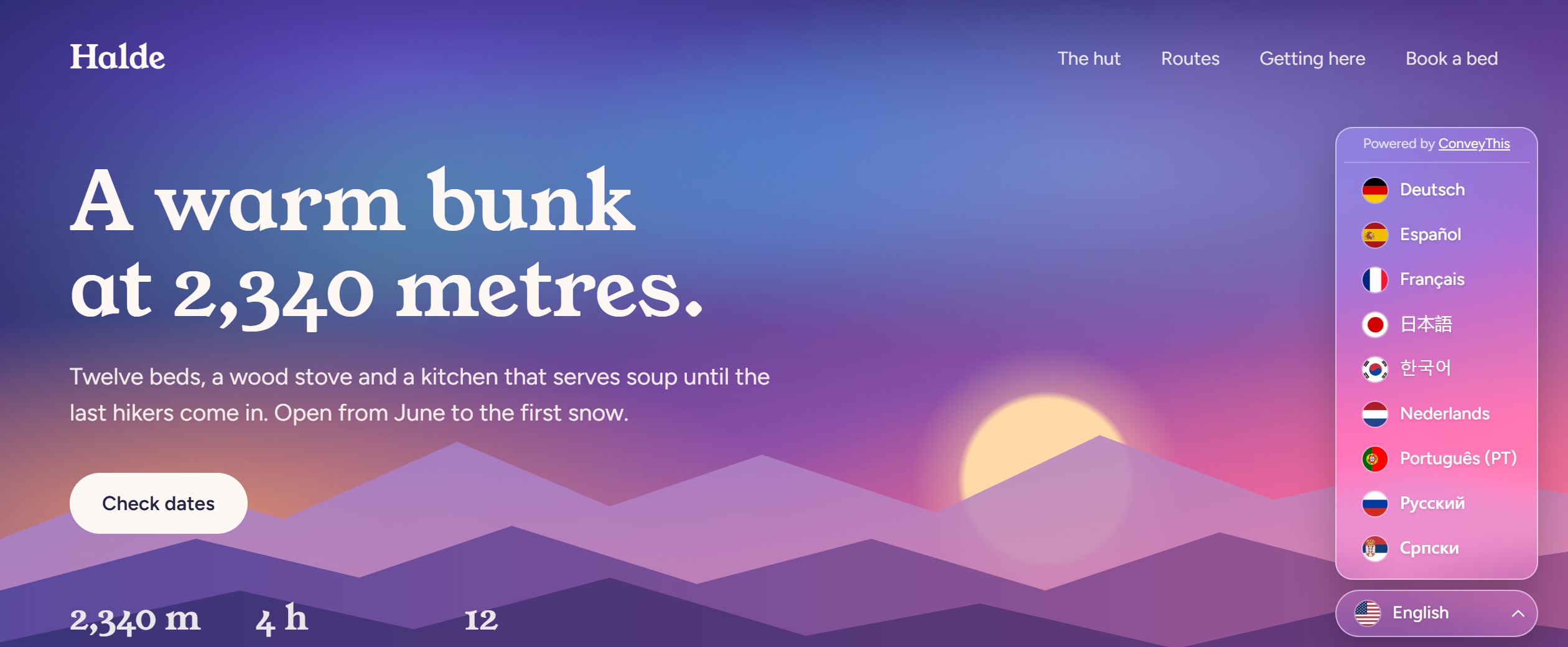
Bubble and Auto share second place. Bubble is a small round button that opens a column of round flags.
Auto switches between a light and a dark look to match whatever is behind it as the visitor scrolls.
Neon is the bold one, dark with a glowing outline. It has a smaller but dedicated following.
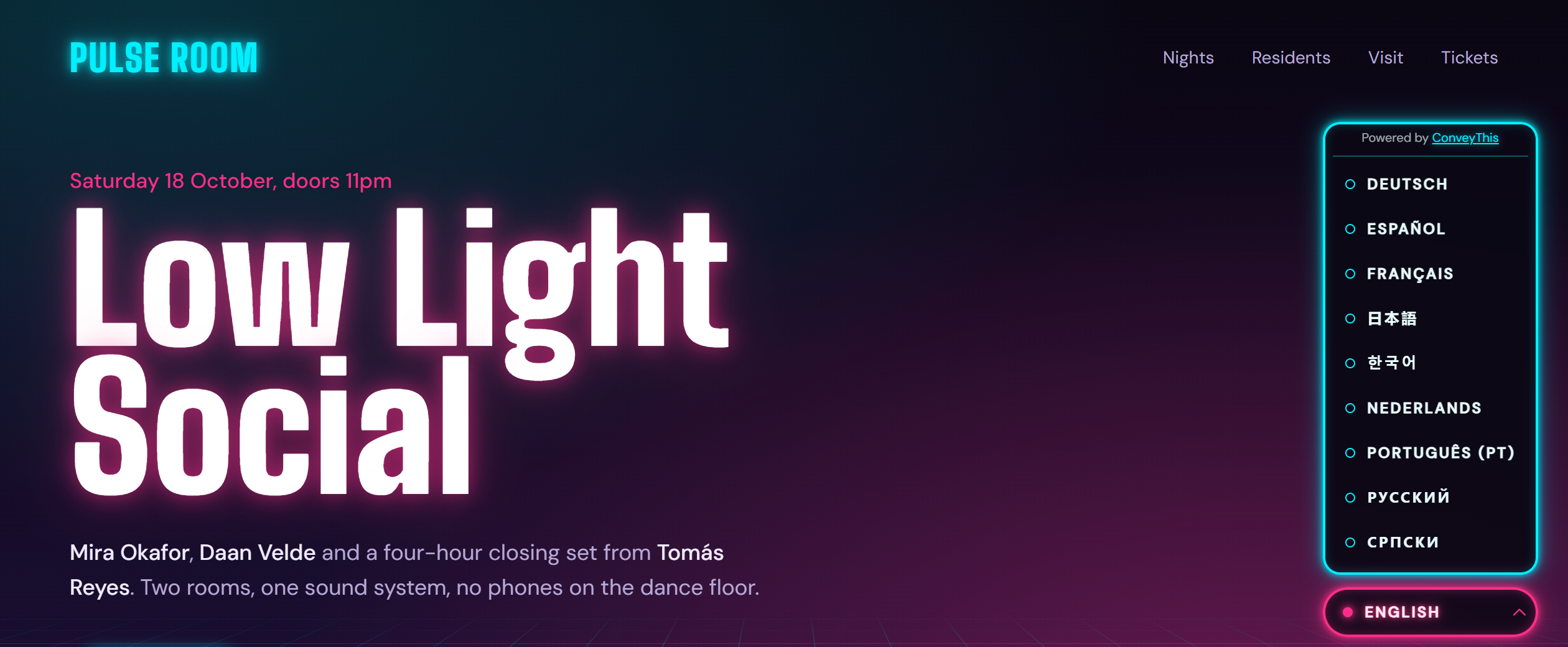
Want to see how each theme works and how to turn one on? Read our switcher themes announcement.
What website owners can learn from these trends
Our sample shows what other website owners chose. Your own audience should make the final decision. Here’s how to use the findings:
- Prioritise languages from your own data. A popular route in our sample is not a reason to add a language. Look at where your visitors come from and which languages their browsers ask for, then start there.
- Starting with one language is normal. Most websites in our sample translate into a single language. Launch one, check the translations on your most important pages, then add more when you see demand.
- Make the switcher easy to find. Visitors should spot it without searching. A corner position, clear language names and a familiar dropdown all help, and showing language names instead of flags avoids confusion when one language is spoken in several countries.
- Test placement on mobile and desktop. A bottom corner can sit on top of a chat button, a cookie banner or a cart button on a phone. Check every page type on a small screen before you settle on a position.
- Plan for multilingual SEO. Translated pages only bring search traffic if search engines can find and understand them. Decide between subdirectories and subdomains, and make sure each language version has correct hreflang tags.
More words for every plan
One more change helps all of these websites. At the end of September we doubled the translated-word limit on every plan, with no price change. The Free plan now includes 10,000 words, often enough for a small website to get started.
What this tells us
Going multilingual isn’t only for big companies. It’s surf schools and manufacturers, nonprofits and study guides, shops and studios, in 120 languages. Most translate into one language, put a small switcher in the corner and make it their own.
Which corner, which flag and which theme would your website choose?
Already using ConveyThis? Open your switcher settings and try a theme. It takes one click, and you can always switch back to Classic.
Not using ConveyThis yet? Start free and add your first language today.
Methodology
This analysis examines aggregated configuration data from more than 1,400 websites using ConveyThis. The research sample does not represent the total number of websites using ConveyThis or the multilingual web as a whole.
The findings reflect configurations observed within the analysed sample. Individual charts may use different sample sizes depending on the availability of relevant data.
Websites were included if they were active and had recorded visitors. Test websites used by the ConveyThis team were excluded. Language, platform and switcher settings reflect each website’s configuration in October 2026, and the platform is the one selected when the website was added. Theme rankings reflect theme settings as of 27 October 2026, three weeks after the themes became available to everyone on 6 October. “Added this year” refers to websites added since 1 January 2026. Percentages are rounded to whole numbers, so some charts add up to slightly more or less than 100%.


