


Reverse-proxy translation usually starts the same way: change DNS, point traffic at the translation service, done.
That story falls apart the moment the site is already on Cloudflare.
Your zone already terminates TLS. Your WAF already filters traffic. Your DNS already uses orange-cloud Proxied records. Pointing the apex somewhere else feels like ripping out the stack you paid for — or worse, creating a routing loop where Cloudflare talks to Cloudflare and nobody can reach the real origin.
That is the problem we built Cloudflare Workers (Orange-to-Orange / O2O) to solve.
I did not want another feature page. I took a site already living on Cloudflare, ran the new ConveyThis setup end to end, and kept notes on what was obvious, what was surprising, and what you should not click by accident.
The problem O2O actually solves
Support hears this often: “We’re on Cloudflare. Can we keep our setup?”
With a classic DNS proxy, the honest answer was: yes, but you will treat ConveyThis like a different network hop. For many Cloudflare teams, that is the wrong pitch. They want translated URLs without abandoning the zone they already manage.
Orange-to-Orange is Cloudflare’s name for traffic that passes through two Cloudflare zones: yours first, then a SaaS provider’s. You enable it by adding a Proxied CNAME in your dashboard that points at the provider’s Cloudflare-for-SaaS hostname. Cloudflare documents the pattern in their O2O overview.
In ConveyThis terms:
- Visitors still hit your Cloudflare zone first (security rules, DNS, caching habits stay put).
- Traffic then routes into our Cloudflare for SaaS zone.
- A Worker fetches your origin HTML and returns the translated page from the edge.
You are not swapping Cloudflare for something else. You are letting Cloudflare talk to Cloudflare on purpose.
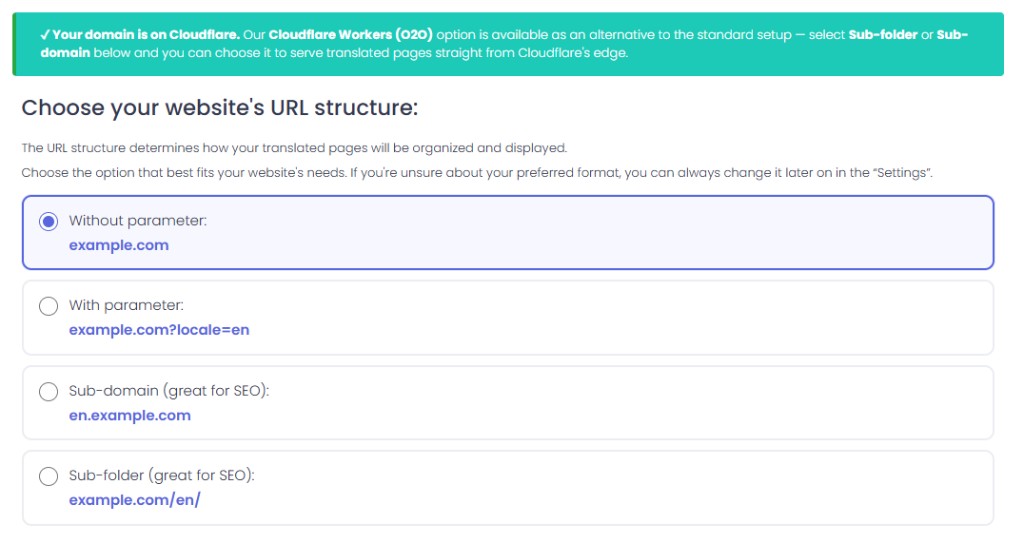
ConveyThis detects that the domain is on Cloudflare and offers the Workers (O2O) option.
What surprised me in setup
I expected a checklist titled “Migrate your DNS to us.” What I got was quieter.
After I added the domain, ConveyThis ran a nameserver check. The banner was blunt: Your domain is on Cloudflare. From there, Sub-folder / Sub-domain unlocked Cloudflare Workers (O2O) as an alternative to the standard DNS proxy — opt-in, not forced.
That mattered more than the marketing copy. The product adapted to the zone I already had, instead of dumping me into generic CNAME docs and hoping I noticed the orange cloud.
I picked Sub-folder (example.com/en/) and switched the serve method to Cloudflare Workers (O2O).
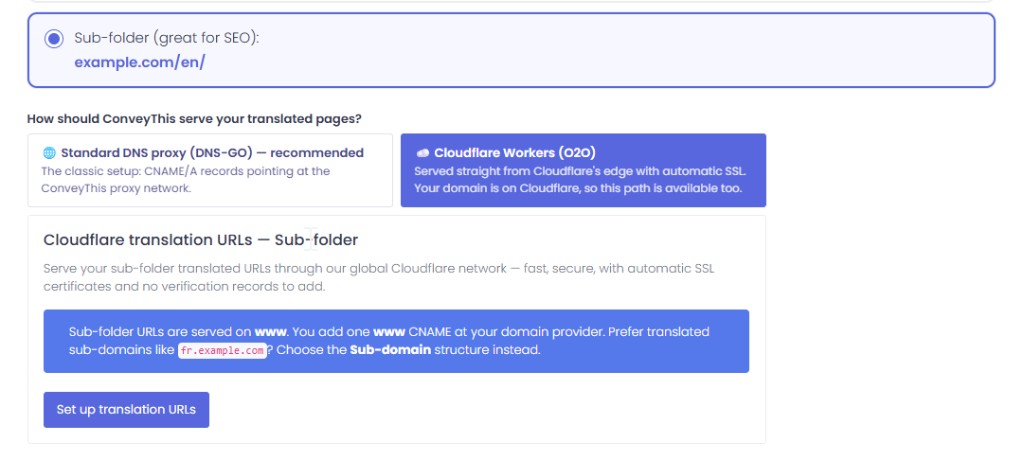
Standard DNS proxy stays available. O2O is the Cloudflare-native option when the zone is detected.
The only DNS detail that actually matters
ConveyThis printed the records. For my Sub-folder run, that meant Proxied CNAMEs toward fallback.conveythis.net — typically @ and www, plus an origin record so the Worker can still reach the real site without looping back into the proxy.
Copy/paste into Cloudflare took under a minute. The non-negotiable rule:
Every routing CNAME must stay Proxied (orange). Grey-cloud / DNS Only breaks O2O. There is no subtle failure mode here — routing simply does not take the Orange-to-Orange path.
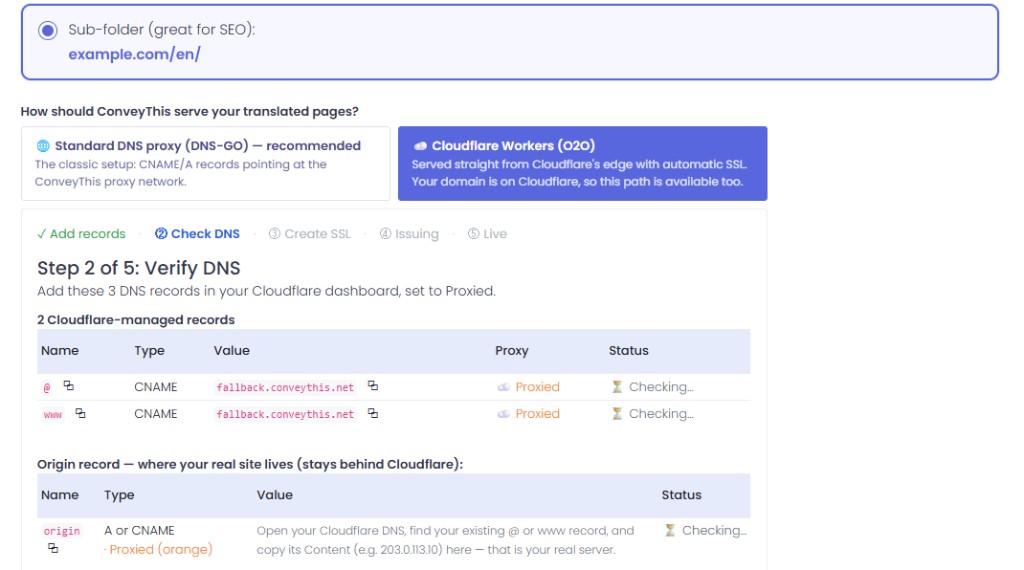
Verify DNS: Proxied @ / www toward fallback.conveythis.net, plus the origin record for the real server.
If you use Sub-domain mode instead, expect one language host per language (and certificates for each). Sub-folder keeps the hostname count smaller — which is why I used it for this test. For the SEO trade-offs between those URL shapes, see subdirectories vs. subdomains for multilingual SEO.
SSL: wait, then re-check
Once the records were in, Cloudflare for SaaS issued certificates. No uploads, no ACME files on the origin, no support ticket.
I refreshed until the table flipped to Active. In my run: a few minutes, then “2 of 2 certificates active.”
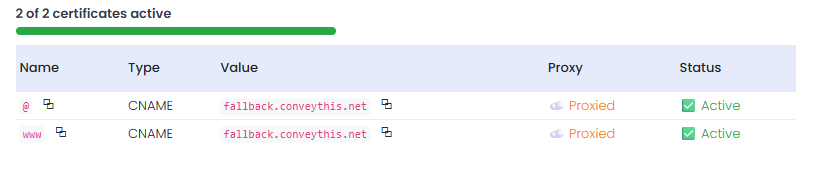
When status is Active, the translated hostnames are ready to hit.
If yours sits on “Issuing…” longer, resist the urge to grey-cloud the records “to speed things up.” That usually makes it worse.
The first translated page
This is the part product demos skip: open a real URL after SSL turns green.
I opened a translated page. Source site unchanged. German copy, language switcher, same layout — served through the Worker path, not a CMS plugin and not a nameserver migration.

The translated page after setup — served through Cloudflare Workers (O2O).
No theme edits. No “install our plugin and pray.” The boring outcome is the point.
What the request actually does
For readers who want the wiring diagram:
- Visitor requests a translated URL.
- Request enters your Cloudflare zone.
- Proxied CNAME hands it to ConveyThis via O2O.
- Our Worker loads tenant config, fetches origin HTML, rewrites text at the edge.
- Translated HTML returns to the visitor; warm pages can be cached for the next hit.
Expensive translation work stays off the visitor’s critical path when the dictionary is warm. Your WAF still saw the request first. That is the whole pitch, compressed.
Mistakes that are easy to make
A few notes from the run that are more useful than another happy ending:
- Grey cloud = broken O2O. If someone on your team “DNS-only for debugging,” put the orange cloud back before you blame ConveyThis.
- SSL lag is normal. Certificates trail DNS by a few minutes. Re-check; don’t rebuild the zone.
- Origin access is the sharp edge. Sub-domain (and some Sub-folder) setups need a way for the Worker to reach the real server — often a Proxied
origin.yourdomain.comrecord, or an origin IP when the host won’t answer for that name. ConveyThis surfaces that in setup; don’t skip the row because it looks optional. - O2O is opt-in. If you prefer the classic proxy, keep it. Detection only offers Workers when the zone is on Cloudflare.
Who should use this
Use Cloudflare Workers (O2O) if:
- DNS for the domain already uses Cloudflare nameservers
- You want translated Sub-folder or Sub-domain URLs
- You care about keeping WAF / Proxied posture in your account
Stick with the standard DNS proxy if the domain is not on Cloudflare yet — or if you are not ready to manage Proxied records in the Cloudflare dashboard. Non-Cloudflare domains should follow the CNAME setup in DNS manager instead.
Bottom line
The run, start to finish:
- Add the domain in ConveyThis
- Confirm the “on Cloudflare” detection
- Choose Sub-folder or Sub-domain → Cloudflare Workers (O2O)
- Paste Proxied CNAMEs (and origin when asked)
- Wait for Active certificates
- Open a translated URL
O2O will not impress anyone with fireworks. It should feel slightly boring: same Cloudflare zone, orange clouds left on, translated pages at the edge.
If your site already lives on Cloudflare, that boredom is the feature.
Frequently asked questions
What is Cloudflare Workers (O2O) in ConveyThis?
It is the Cloudflare-native way to serve translated pages when your domain’s DNS already lives on Cloudflare. Traffic hits your zone first, then routes to ConveyThis through Orange-to-Orange and a Worker that translates HTML at the edge.
Do I need to change my Cloudflare nameservers?
No. O2O assumes the domain is already on Cloudflare. You add Proxied CNAMEs in your existing Cloudflare DNS dashboard.
What DNS records do I add for O2O?
ConveyThis shows the exact list in setup. In this test, Sub-folder O2O used Proxied CNAMEs for @ and www pointing at fallback.conveythis.net, plus an origin record so the Worker can reach the real site. Keep the orange cloud on.
Is O2O better for multilingual SEO than the standard proxy?
Both can use SEO-friendly Sub-folder or Sub-domain URLs. O2O’s advantage is operational: you keep Cloudflare WAF, Proxied posture, and zone control while still getting indexable language URLs. Pair it with solid multilingual SEO (hreflang, canonicals, consistent URL structure).
Can I switch back to the standard DNS proxy later?
Yes. O2O is opt-in. If Workers is not the right fit, you can stay on — or move back to — the classic ConveyThis DNS proxy path from setup / domain settings.
Does this work without a CMS plugin?
Yes. The Worker fetches your live HTML and returns a translated page. You do not need a WordPress/Shopify theme rewrite for the proxy path itself.
Useful resources
Ready to set up Cloudflare Workers (O2O)?
If your domain is already on Cloudflare, add it in ConveyThis, confirm the detection banner, and choose Cloudflare Workers (O2O) on Sub-folder or Sub-domain.
Start with our free plan — or log in and open domain setup to see whether O2O is available for your site.












;fill-opacity:1;'%20d='M%2019.511719%2039.964844%20C%208.304688%2039.964844%200%2031.289062%200%2020.324219%20L%200%2020.230469%20C%200%209.363281%208.160156%200.46875%2019.847656%200.46875%20C%2027.023438%200.46875%2031.320312%202.878906%2034.847656%206.375%20L%2029.519531%2012.492188%20C%2026.59375%209.820312%2023.59375%208.179688%2019.800781%208.179688%20C%2013.390625%208.179688%208.761719%2013.53125%208.761719%2020.085938%20L%208.761719%2020.203125%20C%208.761719%2026.757812%2013.273438%2032.203125%2019.800781%2032.203125%20C%2024.144531%2032.203125%2026.808594%2030.46875%2029.808594%2027.722656%20L%2035.136719%2033.121094%20C%2031.199219%2037.335938%2026.855469%2039.964844%2019.511719%2039.964844%20'/%3e%3cpath%20style='%20stroke:none;fill-rule:nonzero;fill:rgb(26.274511%25,42.352942%25,94.901961%25);fill-opacity:1;'%20d='M%2035.878906%200.0351562%20L%2044.136719%200.0351562%20L%2044.136719%2039.867188%20L%2035.878906%2039.867188%20Z%20M%2035.878906%200.0351562%20'/%3e%3cpath%20style='%20stroke:none;fill-rule:nonzero;fill:rgb(26.274511%25,42.352942%25,94.901961%25);fill-opacity:1;'%20d='M%2059.472656%2016.15625%20C%2056.039062%2016.15625%2053.808594%2018.613281%2053.160156%2022.375%20L%2065.617188%2022.375%20C%2065.113281%2018.664062%2062.953125%2016.15625%2059.472656%2016.15625%20M%2073.535156%2027.578125%20L%2053.28125%2027.578125%20C%2054.097656%2031.335938%2056.710938%2033.3125%2060.40625%2033.3125%20C%2063.191406%2033.3125%2065.183594%2032.445312%2067.464844%2030.300781%20L%2072.191406%2034.492188%20C%2069.480469%2037.867188%2065.566406%2039.941406%2060.289062%2039.941406%20C%2051.527344%2039.941406%2045.070312%2033.769531%2045.070312%2024.832031%20L%2045.070312%2024.710938%20C%2045.070312%2016.347656%2051%209.480469%2059.472656%209.480469%20C%2069.191406%209.480469%2073.65625%2017.074219%2073.65625%2025.363281%20L%2073.65625%2025.457031%20C%2073.65625%2026.300781%2073.609375%2026.808594%2073.535156%2027.578125%20'/%3e%3cpath%20style='%20stroke:none;fill-rule:nonzero;fill:rgb(26.274511%25,42.352942%25,94.901961%25);fill-opacity:1;'%20d='M%2089.375%2039.796875%20L%2081.863281%2039.796875%20L%2070.390625%2010.324219%20L%2079.152344%2010.324219%20L%2085.679688%2029.914062%20L%2092.257812%2010.324219%20L%20100.847656%2010.324219%20Z%20M%2089.375%2039.796875%20'/%3e%3cpath%20style='%20stroke:none;fill-rule:nonzero;fill:rgb(26.274511%25,42.352942%25,94.901961%25);fill-opacity:1;'%20d='M%20111.550781%2016.15625%20C%20108.121094%2016.15625%20105.886719%2018.613281%20105.238281%2022.375%20L%20117.695312%2022.375%20C%20117.191406%2018.664062%20115.03125%2016.15625%20111.550781%2016.15625%20M%20125.617188%2027.578125%20L%20105.359375%2027.578125%20C%20106.175781%2031.335938%20108.792969%2033.3125%20112.488281%2033.3125%20C%20115.246094%2033.3125%20117.265625%2032.445312%20119.542969%2030.300781%20L%20124.273438%2034.492188%20C%20121.558594%2037.867188%20117.648438%2039.941406%20112.367188%2039.941406%20C%20103.609375%2039.941406%2097.152344%2033.769531%2097.152344%2024.832031%20L%2097.152344%2024.710938%20C%2097.152344%2016.347656%20103.078125%209.480469%20111.550781%209.480469%20C%20121.273438%209.480469%20125.734375%2017.074219%20125.734375%2025.363281%20L%20125.734375%2025.457031%20C%20125.734375%2026.300781%20125.6875%2026.808594%20125.617188%2027.578125%20'/%3e%3cpath%20style='%20stroke:none;fill-rule:nonzero;fill:rgb(26.274511%25,42.352942%25,94.901961%25);fill-opacity:1;'%20d='M%20143.566406%2018.757812%20C%20138.070312%2018.757812%20134.710938%2022.085938%20134.710938%2029.074219%20L%20134.710938%2039.867188%20L%20126.457031%2039.867188%20L%20126.457031%2010.613281%20L%20134.710938%2010.613281%20L%20134.710938%2016.519531%20C%20136.390625%2012.46875%20139.128906%209.867188%20144%2010.085938%20L%20144%2018.757812%20Z%20M%20143.566406%2018.757812%20'/%3e%3c/g%3e%3c/svg%3e)




;fill-opacity:1;'%20d='M%20144.558594%2039.894531%20L%20155.4375%209.839844%20C%20155.4375%209.839844%20147.28125%209.839844%20139.121094%2011.515625%20L%20128.867188%2039.894531%20Z%20M%20142.675781%201.78125%20L%20140.585938%207.539062%20C%20148.738281%205.863281%20156.902344%205.863281%20156.902344%205.863281%20L%20158.992188%200.105469%20C%20158.992188%200.105469%20150.832031%200.105469%20142.675781%201.78125%20M%2085.980469%2032.773438%20C%2090.898438%2033.71875%2095.914062%2034.136719%20101.039062%2034.136719%20C%20106.375%2034.136719%20110.140625%2032.984375%20110.554688%2029.320312%20C%20110.765625%2027.640625%20109.089844%2026.382812%20106.167969%2024.707031%20C%20102.816406%2022.824219%2099.894531%2021.878906%2096.960938%2019.886719%20C%2094.03125%2017.898438%2092.78125%2014.859375%2093.71875%2011.507812%20C%2094.871094%207.636719%2097.585938%205.4375%20101.664062%203.34375%20C%20106.480469%200.9375%20110.242188%20-0.0078125%20119.550781%20-0.0078125%20C%20125.40625%20-0.0078125%20131.054688%200.515625%20136.597656%201.667969%20L%20134.609375%207.113281%20C%20129.691406%206.167969%20124.675781%205.75%20119.550781%205.75%20C%20114.214844%205.75%20110.453125%206.90625%20110.035156%2010.570312%20C%20109.828125%2012.246094%20111.5%2013.503906%20114.425781%2015.179688%20C%20117.773438%2017.066406%20120.695312%2018.011719%20123.628906%2020%20C%20126.558594%2021.988281%20127.808594%2025.027344%20126.871094%2028.378906%20C%20125.71875%2032.253906%20123.003906%2034.449219%20118.925781%2036.542969%20C%20114.113281%2038.949219%20110.347656%2039.894531%20101.039062%2039.894531%20C%2095.183594%2039.894531%2089.535156%2039.375%2083.992188%2038.21875%20Z%20M%2062.34375%2039.894531%20L%2071.441406%2014.867188%20C%2074.476562%206.488281%2063.390625%209.527344%2060.875%2011.515625%20C%2058.890625%2012.984375%2055.332031%2016.441406%2054.078125%2020.105469%20L%2046.859375%2040%20L%2031.175781%2040%20L%2040.273438%2014.867188%20C%2043.308594%206.488281%2032.222656%209.527344%2029.710938%2011.515625%20C%2027.722656%2012.984375%2024.167969%2016.441406%2022.910156%2020.105469%20L%2015.691406%2040%20L%200.0078125%2040%20L%2014.441406%200.105469%20C%2019.464844%200.105469%2022.179688%201.257812%2024.375%203.457031%20C%2025.207031%204.289062%2025.734375%205.339844%2026.046875%206.496094%20C%2028.980469%204.714844%2031.589844%203.351562%2033.371094%202.726562%20C%2036.613281%201.46875%2040.691406%200.105469%2045.714844%200.105469%20C%2050.734375%200.105469%2053.453125%201.257812%2055.644531%203.457031%20C%2056.480469%204.289062%2057.007812%205.339844%2057.320312%206.496094%20C%2060.25%204.714844%2062.863281%203.351562%2064.640625%202.726562%20C%2067.886719%201.46875%2071.964844%200.113281%2076.984375%200.113281%20C%2082.007812%200.113281%2084.722656%201.265625%2086.917969%203.464844%20C%2089.21875%205.660156%2089.113281%209.742188%2088.28125%2012.050781%20L%2078.027344%2039.902344%20L%2062.34375%2039.902344%20Z%20M%2062.34375%2039.894531%20'/%3e%3c/g%3e%3c/svg%3e)

;fill-opacity:1;'%20d='M%202.453125%209.882812%20L%202.453125%2012.851562%20L%207.304688%2012.851562%20L%2016.800781%2030.734375%20L%2028.488281%2030.734375%20L%2037.980469%2012.824219%20L%2042.832031%2012.792969%20L%2042.84375%209.882812%20L%2028.328125%209.882812%20L%2028.328125%2012.804688%20L%2032.195312%2012.804688%20L%2025.488281%2025.515625%20L%2018.234375%2012.847656%20L%2023.527344%2012.824219%20L%2023.515625%209.882812%20Z%20M%2096.097656%209.882812%20L%2096.097656%2012.851562%20L%20100.949219%2012.851562%20L%20110.445312%2030.734375%20L%20122.128906%2030.734375%20L%20131.625%2012.824219%20L%20136.476562%2012.792969%20L%20136.484375%209.882812%20L%20121.972656%209.882812%20L%20121.972656%2012.804688%20L%20125.835938%2012.804688%20L%20119.132812%2025.515625%20L%20111.878906%2012.847656%20L%20117.167969%2012.824219%20L%20117.160156%209.882812%20Z%20M%2072.222656%209.882812%20L%2072.222656%2012.851562%20L%2077.078125%2012.851562%20L%2077.082031%2027.453125%20L%2071.96875%2027.453125%20L%2071.96875%2030.707031%20L%2077.085938%2030.734375%20L%20101.3125%2030.734375%20L%20101.3125%2021.027344%20L%2098.15625%2021.027344%20C%2097.984375%2026.167969%2093.542969%2027.457031%2091.675781%2027.457031%20C%2089.960938%2027.457031%2086.640625%2027.453125%2086.640625%2027.453125%20L%2086.640625%2012.847656%20L%2091.417969%2012.824219%20L%2091.410156%209.882812%20Z%20M%2055.890625%209.285156%20C%2047.644531%209.285156%2040.960938%2014.214844%2040.960938%2020.292969%20C%2040.960938%2026.375%2047.644531%2031.304688%2055.890625%2031.304688%20C%2064.136719%2031.304688%2070.824219%2026.375%2070.824219%2020.292969%20C%2070.824219%2014.214844%2064.136719%209.285156%2055.890625%209.285156%20Z%20M%2055.675781%2028.0625%20C%2052.769531%2028.0625%2050.414062%2024.566406%2050.414062%2020.25%20C%2050.414062%2015.933594%2052.769531%2012.4375%2055.675781%2012.4375%20C%2058.582031%2012.4375%2060.941406%2015.933594%2060.941406%2020.25%20C%2060.941406%2024.566406%2058.582031%2028.0625%2055.675781%2028.0625%20Z%20M%20149.539062%208.921875%20C%20141.289062%208.921875%20134.605469%2013.933594%20134.605469%2020.113281%20C%20134.605469%2026.292969%20141.289062%2031.300781%20149.539062%2031.300781%20C%20157.78125%2031.300781%20164.46875%2026.292969%20164.46875%2020.113281%20C%20164.46875%2013.933594%20157.78125%208.921875%20149.539062%208.921875%20Z%20M%20149.324219%2028.007812%20C%20146.417969%2028.007812%20144.0625%2024.453125%20144.0625%2020.066406%20C%20144.0625%2015.679688%20146.417969%2012.125%20149.324219%2012.125%20C%20152.230469%2012.125%20154.585938%2015.679688%20154.585938%2020.066406%20C%20154.585938%2024.453125%20152.230469%2028.007812%20149.324219%2028.007812%20Z%20M%20149.324219%2028.007812%20'/%3e%3c/g%3e%3c/svg%3e)