

As of 2015, the U.S. was regarded as the second-largest Spanish-speaking nation in the world, preceded only by Mexico — a distinction confirmed by the Instituto Cervantes in Spain. That trend has only accelerated. A 2024 study by the Instituto Cervantes, Spanish: A Living Language, confirmed the U.S. still holds that position, with over 60 million Spanish speakers now living across the country — more than the entire populations of Colombia, Spain, or Argentina. (Instituto Cervantes via La Chapulina Verde)
The economic weight behind that population is staggering. According to the Latino Donor Collaborative, U.S. Latino purchasing power reached $3.78 trillion in 2024 — making the U.S. Latino economy the fifth-largest in the world if treated as a standalone country, and one that is growing faster than India’s and China’s. (Latino Donor Collaborative, 2024)
E-commerce currently represents around $500 billion in the marketplace, with sales totaling 11% in retail the past financial year. Providing a platform for e-commerce to the 50 million or more native Spanish-speaking Americans makes clear commercial and economic sense. Yet retail platforms in the U.S. have not yet adopted a multilingual, user-friendly approach — evident from the fact that only 2.45% of U.S. e-commerce sites offer multiple languages. Of the 17% of multilingual American e-merchants, 17% support English and Spanish, 16% French, and 8% German. These Spanish-speaking merchants are active on an important — and largely underserved — consumer base.
How to Organize a Multilingual Platform
From an unofficial standpoint, the U.S. lags behind much of the world from an online multilingual perspective. The linguistic landscape is viewed by U.S. business owners as favoring English as the primary form, with other languages secondary.
You may feel that this is a disadvantage should you want to enter the U.S. market via an English-language site; however, developing a Spanish-friendly site can go a long way in assuring great returns in sales within the U.S. market.
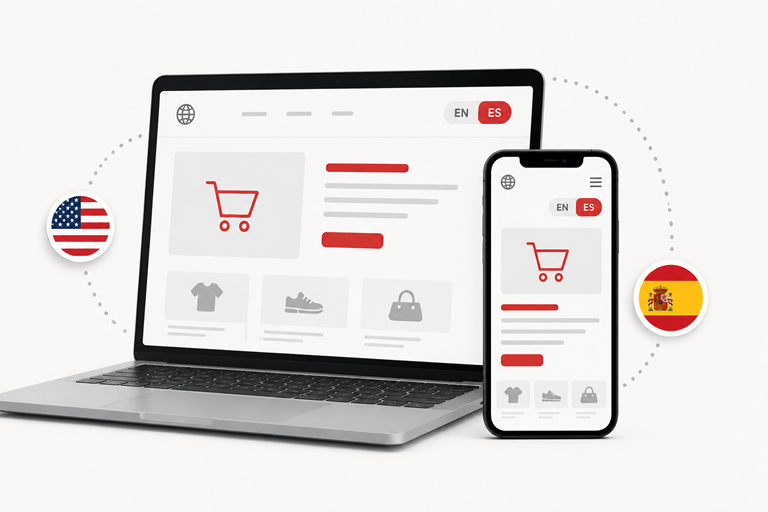
Publishing your online store as fully bilingual, without having to turn to Google Translate, will reach the market of choice on both language levels. For this reason, we have compiled a number of thoughts and ideas on how to take a multilingual approach and define your online presence in a more promising and active way.
Multilingual Americans – English to Spanish
Many of the multi-millions of native Spanish-speaking Americans may be fluent in English, but prefer to keep their interfaces set to Spanish. Bilingual Americans may converse in English, but their software interfaces on their mobile devices and PCs may be kept in Spanish. Google indicators also show that more than 30% of media use within the U.S. is accessed by browsers on Spanish and English interchangeable platforms — including page-viewing, searches, social media, and messaging.
A 2025 report from ThinkNow Research found that 53% of U.S. Hispanic adults actively look for websites or retailers that offer Spanish-language options when shopping online, and that 41% of Hispanic consumers shop online at least once a week. (ThinkNow Research via EMARKETER, 2025) These are not marginal shoppers — they are an engaged, frequent, and growing digital consumer base.
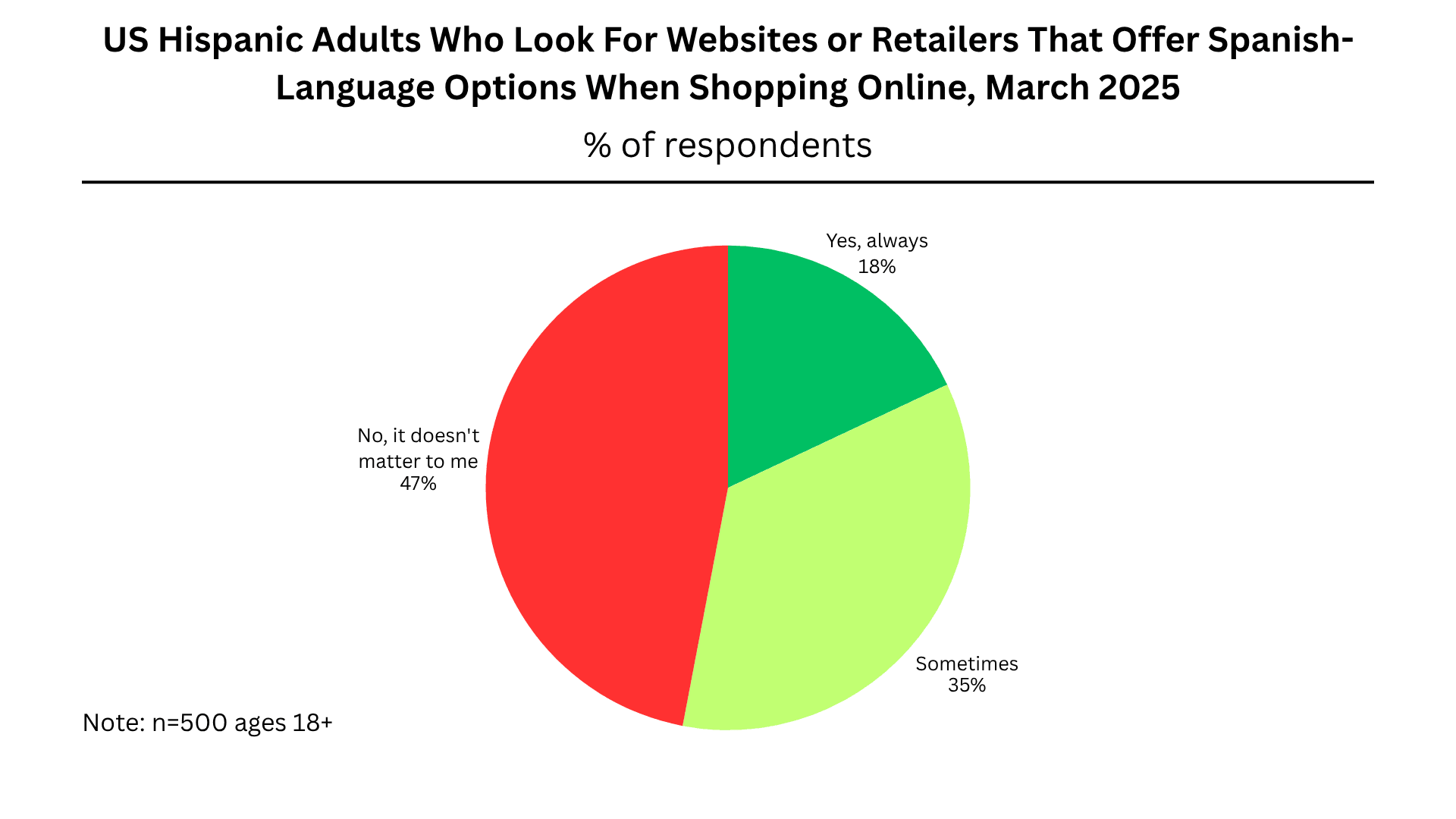
Source: ThinkNow Research, “Clicks vs. Carts: 2025 Shoppers Report,” April 23, 2025
1. Adjusting SEO to Spanish
As a search engine, Google detects the browser language setting of the user and in turn provides content with this in mind. The point here is clear: your SEO may be suffering in the U.S. without Spanish as an option. The benefits of your site being in Spanish are much more lucrative in your larger U.S. markets.
The numbers bear this out. A Google case study on searches related to “car parts” found a cost-per-click of just $0.79 for searches in a Spanish browser, compared to $2.65 in an English-only browser — nearly 3.5x lower in cost — with a 5.7% uplift in clicks when results were provided in Spanish. (MotionPoint, 2024)
If you really want to go all-out to capture a headline place within the U.S. Spanish-speaking consumer market, it will be well worth it to streamline your Spanish-language SEO (ConveyThis has auto-functionality that does all this). Having your SEO status high in both languages will have great benefit to your store’s user-friendly Spanish platform. Search engines are informed of your Spanish user status and grasp the attention of your anticipated customer.
2. Watch Those Data Indicators
After your store is set up with the proper translation, keeping records of data indicators regarding performance on Spanish-language search engines and other data indicator sites will be important to you. To track user language preferences to your site, Google Analytics is an excellent tool. This also includes how they discovered your site — for instance, via Google or a backlink from another site. Google Analytics is a free tool and provides just about everything needed for the small to medium-sized business, with many features to choose from as well. Open the “Geo” tab located in the admin space to see the “Language” statistics.
A Prominent Market – Spanish Online
According to Google, 66% of U.S. Spanish-speaking users noted that they consider online ads — a rate more than 20 percentage points higher than the general U.S. population. (Compass Marketing) From the same observation, a study shows Spanish-English speaking persons to be rather active on market e-commerce centers. Further, Google also notes a study from Ipsos indicating that 83% of Hispanic American mobile internet users make use of online sites via their phones at the actual stores they are visiting — browsing product information while physically present in store.
Meanwhile, 76% of Hispanic adults in the U.S. are more likely to purchase brands that feature diverse people, lifestyles, and cultures in their advertising. (Dentsu, 2024 via EMARKETER) That’s a remarkable signal for any brand investing in culturally relevant content.
With a Spanish online store, browsing will be a breeze. Users will find it comfortable and user-friendly to view product information and to shop. Designing your marketplace on a multi-language platform — with reference to site content and also keeping in mind outbound ads — will benefit greatly on a bilingual level. Other factors need to be kept in mind, though, with regard to the U.S. Spanish-speaking market.
1. Diversity – The Order of the Day
Having the ability to converse in multiple languages may also bring the aspect associated with culture to mind. It’s a natural thing to feel part of such an environment. Hispanic Americans will understand this concept well as they speak both languages fluently.
With this in mind, things such as the campaign against predatory lending practices, active in New York City, bring a distinct message that may present the same in both English and Spanish — but with regard to a product, more thought may be needed.
Advertisers understand this and duly arrange their ad campaigns accordingly, which includes Spanish versions of their ads. They may also use a variety of actors and models, including such tools as slogans, color variations, and copy different from the English ones.
A good example is Payless ShoeSource. They are a discount shoe store located within the U.S. Their focus market was aimed at Hispanic consumers, with TV and online advertising primarily focused toward the Hispanic market and less toward English-speaking ones.
The process of establishing Hispanic-focused consumer advertising strategies — specific and distinct from English concepts — has data to support such a project.
ComScore, a data quantifying company, has statistical information with regard to ad campaigns: campaigns marketed in Spanish only, originating from English campaigns for the overall U.S. market and then adapted to suit Spanish audiences — with text and dialogue translated into Spanish from the English.
The outcome showed without doubt that the Spanish-language audience responded strongly to the strategies incorporated for their preferences.
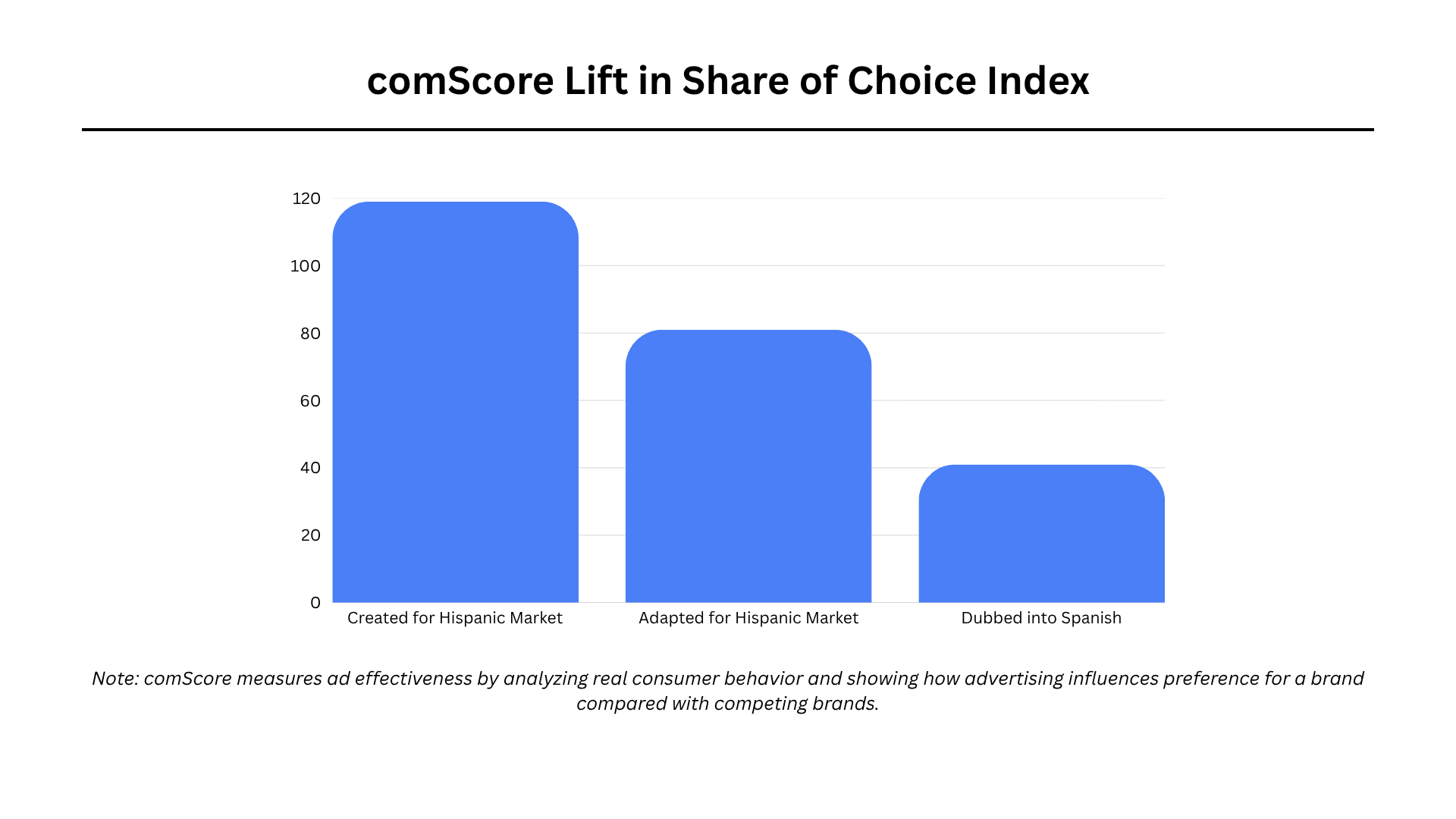
Source: ComScore – Advertising Strategies for Targeting U.S. Hispanics
With regard to metric interpretation, ComScore’s “Lift in Share of Choice” refers to the percentage point increase in “Share of Choice” — a measure of customers within a study group who identified a specific brand or campaign as their preferred choice.
Looking at the ComScore data, the Spanish-speaking American consumer is drawn to and identifies with campaigns freshly oriented toward the Hispanic-speaking customer. So what lessons are learned from this for an online retail provider entering the U.S. Spanish consumer market? The fact remains: a language adaptation is a firm start — Spanish media and copy should closely follow.
As noted in the Google study related to 66% responsiveness to Hispanic-speaking online advertisements, cultural aspects shine through as well. With this in mind, things such as food, traditions, holidays, and family are high on the agenda with the Hispanic-American community.
2. A Step in the Right Direction
As noted before, with the Spanish-speaking native population indicating strong growth within the U.S., brand names have a lucrative outlook in this market. There is a rich culture of Spanish-language social content across television, radio, websites, and other media.
The scale of this opportunity is hard to overstate. According to the ThinkNow report, Hispanic buying power reached $2.3 trillion in 2024 and is projected to hit $2.76 trillion by 2026 — growing at an annual rate of 8.6%, nearly double the national average of 5.5%. (ThinkNow Research, 2024)
ComScore’s study also indicated that Spanish-language online advertising now performs better than television and radio. Exclusive online advertising in Spanish also rated higher under Share of Choice compared to radio and TV ads under similar brands and campaigns.
According to BuiltWith.com, 1.2 million U.S. websites are accessible in Spanish — out of over 120 million site domains within the U.S., placing that figure at just about 1%. Considering the amount of internet usage by Spanish-speaking Americans, it’s clear that very little is catered to their market. The online Spanish-language media landscape falls well short of the scale of Spanish-speaking users. The market is wide open for growth.
3. Streamline the Bilingual Language Flow
As noted in the previous discussion, media devices default to Spanish-language SEO as a default language setting. Addressing the need to improve communication further means streamlining content for Spanish-speakers across all devices.
In the U.S., the bilingual approach as a business strategy would involve acquiring the assistance of Hispanic-speakers who are comfortable with the language and familiar with their communities and cultures. To expand on this approach, adapting the context may go further than a textual interface change — it means working within the walls of linguistic understanding, relating to information and content in writing but with a twist that more closely embraces the associated environment and cultural context. On this level, the philosophy of winning sales across consumer bases will be beneficial within both English and Hispanic user contexts.
Notwithstanding the fact that changing the context requires a special approach on most levels — and not forgetting that insight into the market users, in this case the Hispanic-speaking customer — campaign development tailored to their needs will be essential.
4. Keep Your Online Presence High
Tools of the trade include Univision commercials, advertising on El Sentinel’s online edition, and the use of Google Ads to reach Hispanic markets; however, quality assurance is the key word here. Your website experience needs to be exceptional, at the very least, for your Spanish-speaking consumer.
Creation firm Lionbridge, with a focus on globalization and content, has engaged in research on online media statistics focusing on the U.S. Hispanic user. Of note here is that consistency is the key word in Hispanic markets. Provide an extraordinary service to your Spanish-speaking customer through Hispanic-oriented content — the same as on the English-speaking side — that includes a full web presence in Spanish.
Different Cultures – Different Approaches
From a purely technical perspective, challenges could be somewhat of a different animal, especially regarding the aspects of facilitating multiple language platforms within one page — items such as page displays and paragraph lengths, headline test modules, and other areas.
Depending on software, a few things can go a long way to streamline the process (Squarespace, Webflow, and WordPress, to name a few). The end state is to have a smooth transition and ease of use on this multilingual platform of English and Spanish.
Considering the aspect of design, understanding end-user reactions within this medium is important. We have a few tricks that may help toward this goal — including visual media in the language of choice (we offer assistance with that), including forms, popups, and other tools you may need on your site.
Multilingual Understanding – A Way Forward
Not being a Spanish-speaker yourself, your site can be absolutely on par — with your marketing just as strong as the English side. ConveyThis.com is a great tool on this side of development, providing superb translation for your Spanish site including multiple languages if required, all within your dashboard. Assistance from a native Hispanic-speaking translator to verify your site is also a good idea.
From “Untapped and Underserved” to the Spanish-English Bilingual Boom
Maintaining your website’s SEO and translating the website to Spanish while keeping a tight rein on Spanish-language search engine platforms is a sure-fire way to be an online force within the bilingual U.S. marketplace.
These can all be done within ConveyThis.com, regardless of the platform in use. With regard to media format, video and image replacement between languages, translation customization, and Spanish content at all levels are possible — while maintaining your English-associated branding and standing — all done within a short period of time.












;fill-opacity:1;'%20d='M%2019.511719%2039.964844%20C%208.304688%2039.964844%200%2031.289062%200%2020.324219%20L%200%2020.230469%20C%200%209.363281%208.160156%200.46875%2019.847656%200.46875%20C%2027.023438%200.46875%2031.320312%202.878906%2034.847656%206.375%20L%2029.519531%2012.492188%20C%2026.59375%209.820312%2023.59375%208.179688%2019.800781%208.179688%20C%2013.390625%208.179688%208.761719%2013.53125%208.761719%2020.085938%20L%208.761719%2020.203125%20C%208.761719%2026.757812%2013.273438%2032.203125%2019.800781%2032.203125%20C%2024.144531%2032.203125%2026.808594%2030.46875%2029.808594%2027.722656%20L%2035.136719%2033.121094%20C%2031.199219%2037.335938%2026.855469%2039.964844%2019.511719%2039.964844%20'/%3e%3cpath%20style='%20stroke:none;fill-rule:nonzero;fill:rgb(26.274511%25,42.352942%25,94.901961%25);fill-opacity:1;'%20d='M%2035.878906%200.0351562%20L%2044.136719%200.0351562%20L%2044.136719%2039.867188%20L%2035.878906%2039.867188%20Z%20M%2035.878906%200.0351562%20'/%3e%3cpath%20style='%20stroke:none;fill-rule:nonzero;fill:rgb(26.274511%25,42.352942%25,94.901961%25);fill-opacity:1;'%20d='M%2059.472656%2016.15625%20C%2056.039062%2016.15625%2053.808594%2018.613281%2053.160156%2022.375%20L%2065.617188%2022.375%20C%2065.113281%2018.664062%2062.953125%2016.15625%2059.472656%2016.15625%20M%2073.535156%2027.578125%20L%2053.28125%2027.578125%20C%2054.097656%2031.335938%2056.710938%2033.3125%2060.40625%2033.3125%20C%2063.191406%2033.3125%2065.183594%2032.445312%2067.464844%2030.300781%20L%2072.191406%2034.492188%20C%2069.480469%2037.867188%2065.566406%2039.941406%2060.289062%2039.941406%20C%2051.527344%2039.941406%2045.070312%2033.769531%2045.070312%2024.832031%20L%2045.070312%2024.710938%20C%2045.070312%2016.347656%2051%209.480469%2059.472656%209.480469%20C%2069.191406%209.480469%2073.65625%2017.074219%2073.65625%2025.363281%20L%2073.65625%2025.457031%20C%2073.65625%2026.300781%2073.609375%2026.808594%2073.535156%2027.578125%20'/%3e%3cpath%20style='%20stroke:none;fill-rule:nonzero;fill:rgb(26.274511%25,42.352942%25,94.901961%25);fill-opacity:1;'%20d='M%2089.375%2039.796875%20L%2081.863281%2039.796875%20L%2070.390625%2010.324219%20L%2079.152344%2010.324219%20L%2085.679688%2029.914062%20L%2092.257812%2010.324219%20L%20100.847656%2010.324219%20Z%20M%2089.375%2039.796875%20'/%3e%3cpath%20style='%20stroke:none;fill-rule:nonzero;fill:rgb(26.274511%25,42.352942%25,94.901961%25);fill-opacity:1;'%20d='M%20111.550781%2016.15625%20C%20108.121094%2016.15625%20105.886719%2018.613281%20105.238281%2022.375%20L%20117.695312%2022.375%20C%20117.191406%2018.664062%20115.03125%2016.15625%20111.550781%2016.15625%20M%20125.617188%2027.578125%20L%20105.359375%2027.578125%20C%20106.175781%2031.335938%20108.792969%2033.3125%20112.488281%2033.3125%20C%20115.246094%2033.3125%20117.265625%2032.445312%20119.542969%2030.300781%20L%20124.273438%2034.492188%20C%20121.558594%2037.867188%20117.648438%2039.941406%20112.367188%2039.941406%20C%20103.609375%2039.941406%2097.152344%2033.769531%2097.152344%2024.832031%20L%2097.152344%2024.710938%20C%2097.152344%2016.347656%20103.078125%209.480469%20111.550781%209.480469%20C%20121.273438%209.480469%20125.734375%2017.074219%20125.734375%2025.363281%20L%20125.734375%2025.457031%20C%20125.734375%2026.300781%20125.6875%2026.808594%20125.617188%2027.578125%20'/%3e%3cpath%20style='%20stroke:none;fill-rule:nonzero;fill:rgb(26.274511%25,42.352942%25,94.901961%25);fill-opacity:1;'%20d='M%20143.566406%2018.757812%20C%20138.070312%2018.757812%20134.710938%2022.085938%20134.710938%2029.074219%20L%20134.710938%2039.867188%20L%20126.457031%2039.867188%20L%20126.457031%2010.613281%20L%20134.710938%2010.613281%20L%20134.710938%2016.519531%20C%20136.390625%2012.46875%20139.128906%209.867188%20144%2010.085938%20L%20144%2018.757812%20Z%20M%20143.566406%2018.757812%20'/%3e%3c/g%3e%3c/svg%3e)




;fill-opacity:1;'%20d='M%20144.558594%2039.894531%20L%20155.4375%209.839844%20C%20155.4375%209.839844%20147.28125%209.839844%20139.121094%2011.515625%20L%20128.867188%2039.894531%20Z%20M%20142.675781%201.78125%20L%20140.585938%207.539062%20C%20148.738281%205.863281%20156.902344%205.863281%20156.902344%205.863281%20L%20158.992188%200.105469%20C%20158.992188%200.105469%20150.832031%200.105469%20142.675781%201.78125%20M%2085.980469%2032.773438%20C%2090.898438%2033.71875%2095.914062%2034.136719%20101.039062%2034.136719%20C%20106.375%2034.136719%20110.140625%2032.984375%20110.554688%2029.320312%20C%20110.765625%2027.640625%20109.089844%2026.382812%20106.167969%2024.707031%20C%20102.816406%2022.824219%2099.894531%2021.878906%2096.960938%2019.886719%20C%2094.03125%2017.898438%2092.78125%2014.859375%2093.71875%2011.507812%20C%2094.871094%207.636719%2097.585938%205.4375%20101.664062%203.34375%20C%20106.480469%200.9375%20110.242188%20-0.0078125%20119.550781%20-0.0078125%20C%20125.40625%20-0.0078125%20131.054688%200.515625%20136.597656%201.667969%20L%20134.609375%207.113281%20C%20129.691406%206.167969%20124.675781%205.75%20119.550781%205.75%20C%20114.214844%205.75%20110.453125%206.90625%20110.035156%2010.570312%20C%20109.828125%2012.246094%20111.5%2013.503906%20114.425781%2015.179688%20C%20117.773438%2017.066406%20120.695312%2018.011719%20123.628906%2020%20C%20126.558594%2021.988281%20127.808594%2025.027344%20126.871094%2028.378906%20C%20125.71875%2032.253906%20123.003906%2034.449219%20118.925781%2036.542969%20C%20114.113281%2038.949219%20110.347656%2039.894531%20101.039062%2039.894531%20C%2095.183594%2039.894531%2089.535156%2039.375%2083.992188%2038.21875%20Z%20M%2062.34375%2039.894531%20L%2071.441406%2014.867188%20C%2074.476562%206.488281%2063.390625%209.527344%2060.875%2011.515625%20C%2058.890625%2012.984375%2055.332031%2016.441406%2054.078125%2020.105469%20L%2046.859375%2040%20L%2031.175781%2040%20L%2040.273438%2014.867188%20C%2043.308594%206.488281%2032.222656%209.527344%2029.710938%2011.515625%20C%2027.722656%2012.984375%2024.167969%2016.441406%2022.910156%2020.105469%20L%2015.691406%2040%20L%200.0078125%2040%20L%2014.441406%200.105469%20C%2019.464844%200.105469%2022.179688%201.257812%2024.375%203.457031%20C%2025.207031%204.289062%2025.734375%205.339844%2026.046875%206.496094%20C%2028.980469%204.714844%2031.589844%203.351562%2033.371094%202.726562%20C%2036.613281%201.46875%2040.691406%200.105469%2045.714844%200.105469%20C%2050.734375%200.105469%2053.453125%201.257812%2055.644531%203.457031%20C%2056.480469%204.289062%2057.007812%205.339844%2057.320312%206.496094%20C%2060.25%204.714844%2062.863281%203.351562%2064.640625%202.726562%20C%2067.886719%201.46875%2071.964844%200.113281%2076.984375%200.113281%20C%2082.007812%200.113281%2084.722656%201.265625%2086.917969%203.464844%20C%2089.21875%205.660156%2089.113281%209.742188%2088.28125%2012.050781%20L%2078.027344%2039.902344%20L%2062.34375%2039.902344%20Z%20M%2062.34375%2039.894531%20'/%3e%3c/g%3e%3c/svg%3e)

;fill-opacity:1;'%20d='M%202.453125%209.882812%20L%202.453125%2012.851562%20L%207.304688%2012.851562%20L%2016.800781%2030.734375%20L%2028.488281%2030.734375%20L%2037.980469%2012.824219%20L%2042.832031%2012.792969%20L%2042.84375%209.882812%20L%2028.328125%209.882812%20L%2028.328125%2012.804688%20L%2032.195312%2012.804688%20L%2025.488281%2025.515625%20L%2018.234375%2012.847656%20L%2023.527344%2012.824219%20L%2023.515625%209.882812%20Z%20M%2096.097656%209.882812%20L%2096.097656%2012.851562%20L%20100.949219%2012.851562%20L%20110.445312%2030.734375%20L%20122.128906%2030.734375%20L%20131.625%2012.824219%20L%20136.476562%2012.792969%20L%20136.484375%209.882812%20L%20121.972656%209.882812%20L%20121.972656%2012.804688%20L%20125.835938%2012.804688%20L%20119.132812%2025.515625%20L%20111.878906%2012.847656%20L%20117.167969%2012.824219%20L%20117.160156%209.882812%20Z%20M%2072.222656%209.882812%20L%2072.222656%2012.851562%20L%2077.078125%2012.851562%20L%2077.082031%2027.453125%20L%2071.96875%2027.453125%20L%2071.96875%2030.707031%20L%2077.085938%2030.734375%20L%20101.3125%2030.734375%20L%20101.3125%2021.027344%20L%2098.15625%2021.027344%20C%2097.984375%2026.167969%2093.542969%2027.457031%2091.675781%2027.457031%20C%2089.960938%2027.457031%2086.640625%2027.453125%2086.640625%2027.453125%20L%2086.640625%2012.847656%20L%2091.417969%2012.824219%20L%2091.410156%209.882812%20Z%20M%2055.890625%209.285156%20C%2047.644531%209.285156%2040.960938%2014.214844%2040.960938%2020.292969%20C%2040.960938%2026.375%2047.644531%2031.304688%2055.890625%2031.304688%20C%2064.136719%2031.304688%2070.824219%2026.375%2070.824219%2020.292969%20C%2070.824219%2014.214844%2064.136719%209.285156%2055.890625%209.285156%20Z%20M%2055.675781%2028.0625%20C%2052.769531%2028.0625%2050.414062%2024.566406%2050.414062%2020.25%20C%2050.414062%2015.933594%2052.769531%2012.4375%2055.675781%2012.4375%20C%2058.582031%2012.4375%2060.941406%2015.933594%2060.941406%2020.25%20C%2060.941406%2024.566406%2058.582031%2028.0625%2055.675781%2028.0625%20Z%20M%20149.539062%208.921875%20C%20141.289062%208.921875%20134.605469%2013.933594%20134.605469%2020.113281%20C%20134.605469%2026.292969%20141.289062%2031.300781%20149.539062%2031.300781%20C%20157.78125%2031.300781%20164.46875%2026.292969%20164.46875%2020.113281%20C%20164.46875%2013.933594%20157.78125%208.921875%20149.539062%208.921875%20Z%20M%20149.324219%2028.007812%20C%20146.417969%2028.007812%20144.0625%2024.453125%20144.0625%2020.066406%20C%20144.0625%2015.679688%20146.417969%2012.125%20149.324219%2012.125%20C%20152.230469%2012.125%20154.585938%2015.679688%20154.585938%2020.066406%20C%20154.585938%2024.453125%20152.230469%2028.007812%20149.324219%2028.007812%20Z%20M%20149.324219%2028.007812%20'/%3e%3c/g%3e%3c/svg%3e)