

How to Translate a Website in 2026?
Running a business without a website today raises a few important questions:
- Is it even possible anymore?
- Can it stay competitive without an online presence?
- How will potential customers discover it?
- Can traditional word-of-mouth compete with digital visibility?
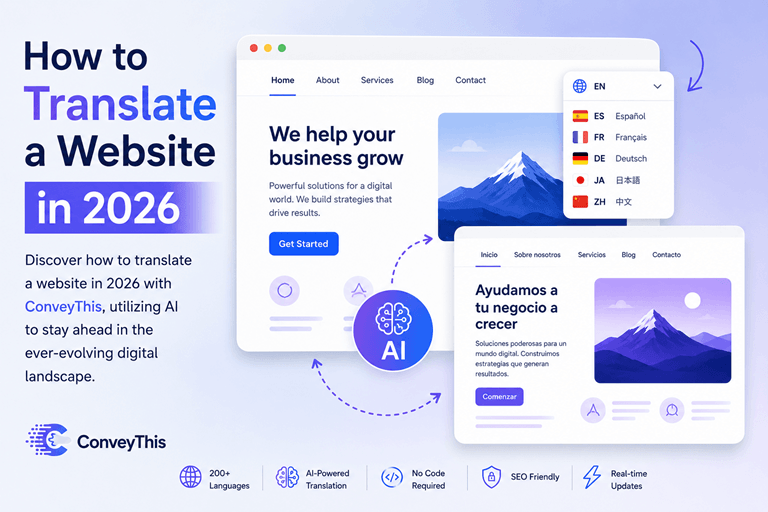
In 2026, a website is no longer just an option — it’s the foundation of your business presence.
Why a Website Matters More Than Ever
While word-of-mouth marketing is still powerful, digital discovery has completely changed how customers find and trust businesses. Today, your business can be discovered instantly through search engines, social media, or even AI-powered assistants. Before making a purchase, booking a service, or even contacting a company, most users first search online. Your website often becomes the first impression customers have of your brand. And first impressions happen fast.
A modern website is not just a digital brochure anymore. It acts as your storefront, sales representative, support center, and marketing platform all at once. Whether someone discovers your business through Google, social media, YouTube, or AI-powered search tools, they expect a professional online experience that feels trustworthy, fast, and easy to navigate.
A website acts as your central hub where customers can:
- Learn about your products or services
- Explore your brand story
- Contact you instantly
- Shop or book services online
- Stay updated with your latest news
Combined with a strong marketing strategy, your website becomes your most valuable business asset. As competition online continues to grow, businesses are no longer competing only locally. Even small companies now compete with brands from different cities, countries, and marketplaces. This makes website quality, accessibility, and multilingual support more important than ever before. Users expect websites to load quickly, work perfectly on mobile devices, and provide information in a language they understand comfortably. If your website cannot meet those expectations, visitors may leave within seconds and continue their search elsewhere.
Building a Website That Actually Works
Some businesses rely on local listings as a starting point. Others invest in SEO-driven websites to reach broader audiences. But having a website alone is not enough anymore.
To stand out, you need:
- Clear messaging
- Strong content structure
- SEO optimization
- Mobile responsiveness
- Multilingual accessibility
This is where translation and localization become essential. This is especially important for businesses planning to expand internationally. Customers naturally trust brands more when they can browse products, read information, and complete purchases in their native language. Even bilingual users often prefer shopping and researching in the language they use every day. A multilingual website helps remove friction from the customer journey. Instead of forcing visitors to translate pages manually or guess the meaning of your content, localization creates a seamless and familiar experience that feels specifically designed for them.
Key Pages Every Website Should Have
To create a complete user experience, your website should include:
About – let the world know how it all started, your mission, your vision.
Product/Service – specifications, benefits, advantages, why should we buy it or hire you?
Blog – share updates, stories that would inspire others and motivate them to come back regularly for a second purchase.
Contact – this will be your link to customers, phone, email, social media channels, live chat, etc.
Some important details to share:
Images – adapt them to your target market.
Location – a physical store where we could find you.
Schedule – working hours.
Links (on the sidebar or footer widgets) – this could be interesting websites, posts, videos, audios, anything that’s related to your business that may catch customer’s interest.
Social Media Channels – this is one of the most common ways for customers to connect to businesses, most of their comments may be a good sign that your work is on the right path, so you want to keep your attention on the things that make your customers happy.
What Information Should Be Localized?
Many businesses make the mistake of focusing only on translating text while ignoring the rest of the user experience. However, localization goes much further than words alone. Colors, images, layouts, examples, humor, payment methods, and even calls-to-action may perform differently depending on the region and culture. For example, certain colors may symbolize trust in one country but represent warning or negativity in another. The same marketing message that works perfectly in the United States may sound unnatural or ineffective in Japan, Germany, or Brazil. Proper localization helps businesses avoid these cultural gaps while creating a more authentic connection with international audiences.
When expanding internationally, translation alone is not enough. You also need localization — adapting your content to different cultures and expectations. Important elements include:
- Images that match the target audience
- Local date, time, and number formats
- Currency and pricing structure
- Cultural tone and messaging
- Layout adjustments for different languages (including RTL languages)
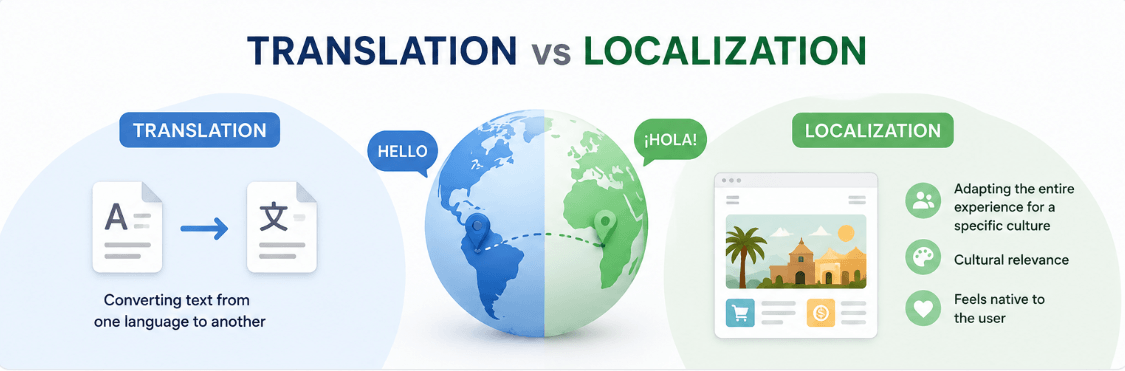
Translation vs Localization
A simple way to understand the difference:
- Translation = converting text from one language to another
- Localization = adapting the entire experience for a specific culture
Localization ensures your website feels “native” to the user, not just translated.
Human Translation vs Machine Translation
Today’s tools have made translation faster than ever, but quality still depends on your goals. One of the biggest questions businesses ask when creating multilingual websites is whether they should rely on human translators or AI-powered translation tools. The answer depends on the type of content you are publishing, your growth goals, and how important accuracy is for your brand. In reality, most successful companies combine both approaches to balance scalability, speed, and quality.
| Type | Best For | Advantages | Limitations |
|---|---|---|---|
| Human Translation | Marketing content, brand messaging, legal or sensitive content | Natural tone, strong cultural accuracy, context-aware writing | Higher cost, slower turnaround |
| AI / Machine Translation | Large-scale content, fast deployment, draft translations | Fast, cost-effective, scalable across many languages | Can miss nuance, tone, and cultural context |
Over the last few years, AI translation quality has improved significantly thanks to neural machine translation and large language models. Modern tools can now generate surprisingly natural translations in seconds. However, AI still struggles with emotional nuance, humor, cultural context, and industry-specific terminology. This is why many businesses use AI translation as a starting point and then rely on human editors or native-speaking reviewers to refine the final result. This hybrid workflow allows companies to scale content production while maintaining professional quality standards.
Start Translating your website now!
Why SEO Matters in Multilingual Websites
A translated website is not automatically SEO-friendly. To rank in international search engines, you need:
- Local keyword research
- Proper URL structure (subfolders or subdomains)
- Hreflang tags
- Localized metadata (titles, descriptions)
- Region-specific content strategy
Without SEO localization, even a perfectly translated website may stay invisible. Search behavior also changes from country to country. People in different regions may search for the same product using completely different keywords, phrases, or terminology. Simply translating keywords word-for-word often produces poor SEO performance because users may not actually search using those exact terms. Effective multilingual SEO requires understanding how local audiences search online, what questions they ask, and how search intent differs across markets. Businesses that invest in localized SEO strategies usually gain significantly higher visibility and better conversion rates internationally.
How Modern Website Translation Works in 2026
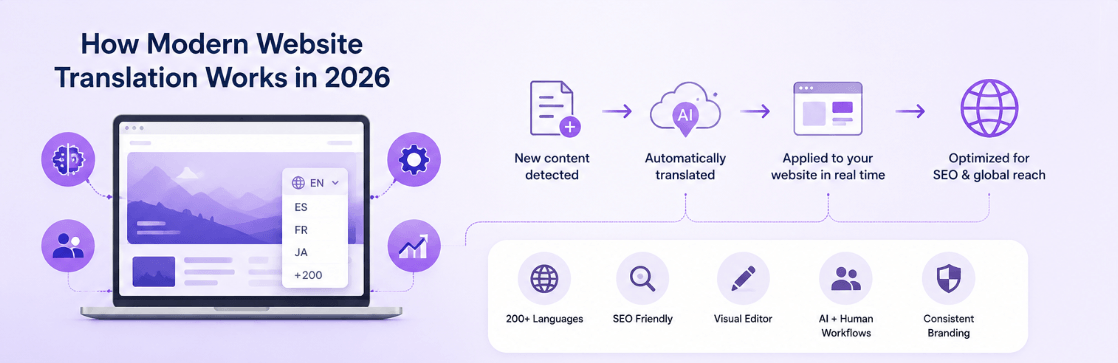
In the past, creating multilingual websites was a slow and expensive process that required building separate versions of each page manually. Today, website translation platforms automate much of this workflow, making multilingual expansion accessible even for small businesses and startups. Modern translation systems can automatically detect new content, translate updates in real time, and optimize translated pages for international SEO. This allows companies to scale globally much faster than before while maintaining a consistent user experience across languages. Modern tools allow automatic translation, real-time updates, and SEO optimization without manual duplication of pages.
One of the leading solutions is ConveyThis, which helps businesses:
- Automatically translate websites into 210 languages
- Apply SEO-friendly multilingual structure
- Manage translations through a visual editor
- Combine AI + human translation workflows
- Maintain consistent branding across languages
How to Install a Website Translation Plugin (Example Workflow)
A typical setup process looks like this:
- Create a ConveyThis account
- Add the translation plugin for your domain following the setup instructions for your CMS
- Select your source and target languages
- Generate your API key
- Enable automatic translation by activating the ConveyThis widget
- Customize the language switcher
- Edit translations using our Visual Editor
Once activated, your website becomes multilingual in minutes!
Choosing the Right Languages
You don’t need to translate into every language at once. Choosing which languages to support should be based on actual business opportunities rather than assumptions. Website analytics, customer inquiries, shipping destinations, and international traffic reports can help identify which markets are already interested in your products or services. Starting with a smaller group of strategically important languages often produces better results than trying to launch globally all at once. Once those markets perform successfully, additional languages can gradually be added over time. Start with your local languages and high-impact markets such as:
- English
- Spanish
- French
- German
- Portuguese
- Japanese
- Arabic
- Chinese
Focus on where your audience actually is, not just global popularity. Familiarize yourself with the full list of languages available for integration into your website.
Common Mistakes to Avoid
Many businesses lose performance because of:
- Direct word-for-word translation
- Ignoring SEO localization
- Poor cultural adaptation
- Not updating translated content regularly
- Using inconsistent terminology
Avoiding these mistakes significantly improves conversion rates.
Final Thoughts
Website translation is no longer a feature reserved for enterprise companies with massive budgets. Today, businesses of every size can build multilingual experiences that feel professional, accessible, and optimized for global audiences. As AI technology, international e-commerce, and multilingual search continue to evolve, companies that invest in localization early will gain a major competitive advantage in the years ahead.
A properly localized website helps businesses connect with international audiences more effectively, improve SEO visibility, increase engagement, and build long-term customer trust. Whether you are running a small business, an online store, or a growing SaaS platform, multilingual accessibility can open the door to entirely new markets and opportunities. The internet has made global business more accessible than ever before. The companies that succeed internationally will be the ones that communicate clearly, adapt culturally, and make customers feel understood in every language they support.
Related: How to translate an entire website · How to add a translate widget to your website
About the author
Alex Buran, Founder of ConveyThis
Alex has spent the last decade building infrastructure for multilingual websites. He writes about localization, AI search, and the technical side of going global.
LinkedIn: https://www.linkedin.com/in/alexburan/
Want to see how ConveyThis handles your specific stack? Book a 30-minute enterprise demo and we’ll walk through your site, languages, and workflow in real time — no slides, no implementation services upsell. Book an enterprise demo












;fill-opacity:1;'%20d='M%2019.511719%2039.964844%20C%208.304688%2039.964844%200%2031.289062%200%2020.324219%20L%200%2020.230469%20C%200%209.363281%208.160156%200.46875%2019.847656%200.46875%20C%2027.023438%200.46875%2031.320312%202.878906%2034.847656%206.375%20L%2029.519531%2012.492188%20C%2026.59375%209.820312%2023.59375%208.179688%2019.800781%208.179688%20C%2013.390625%208.179688%208.761719%2013.53125%208.761719%2020.085938%20L%208.761719%2020.203125%20C%208.761719%2026.757812%2013.273438%2032.203125%2019.800781%2032.203125%20C%2024.144531%2032.203125%2026.808594%2030.46875%2029.808594%2027.722656%20L%2035.136719%2033.121094%20C%2031.199219%2037.335938%2026.855469%2039.964844%2019.511719%2039.964844%20'/%3e%3cpath%20style='%20stroke:none;fill-rule:nonzero;fill:rgb(26.274511%25,42.352942%25,94.901961%25);fill-opacity:1;'%20d='M%2035.878906%200.0351562%20L%2044.136719%200.0351562%20L%2044.136719%2039.867188%20L%2035.878906%2039.867188%20Z%20M%2035.878906%200.0351562%20'/%3e%3cpath%20style='%20stroke:none;fill-rule:nonzero;fill:rgb(26.274511%25,42.352942%25,94.901961%25);fill-opacity:1;'%20d='M%2059.472656%2016.15625%20C%2056.039062%2016.15625%2053.808594%2018.613281%2053.160156%2022.375%20L%2065.617188%2022.375%20C%2065.113281%2018.664062%2062.953125%2016.15625%2059.472656%2016.15625%20M%2073.535156%2027.578125%20L%2053.28125%2027.578125%20C%2054.097656%2031.335938%2056.710938%2033.3125%2060.40625%2033.3125%20C%2063.191406%2033.3125%2065.183594%2032.445312%2067.464844%2030.300781%20L%2072.191406%2034.492188%20C%2069.480469%2037.867188%2065.566406%2039.941406%2060.289062%2039.941406%20C%2051.527344%2039.941406%2045.070312%2033.769531%2045.070312%2024.832031%20L%2045.070312%2024.710938%20C%2045.070312%2016.347656%2051%209.480469%2059.472656%209.480469%20C%2069.191406%209.480469%2073.65625%2017.074219%2073.65625%2025.363281%20L%2073.65625%2025.457031%20C%2073.65625%2026.300781%2073.609375%2026.808594%2073.535156%2027.578125%20'/%3e%3cpath%20style='%20stroke:none;fill-rule:nonzero;fill:rgb(26.274511%25,42.352942%25,94.901961%25);fill-opacity:1;'%20d='M%2089.375%2039.796875%20L%2081.863281%2039.796875%20L%2070.390625%2010.324219%20L%2079.152344%2010.324219%20L%2085.679688%2029.914062%20L%2092.257812%2010.324219%20L%20100.847656%2010.324219%20Z%20M%2089.375%2039.796875%20'/%3e%3cpath%20style='%20stroke:none;fill-rule:nonzero;fill:rgb(26.274511%25,42.352942%25,94.901961%25);fill-opacity:1;'%20d='M%20111.550781%2016.15625%20C%20108.121094%2016.15625%20105.886719%2018.613281%20105.238281%2022.375%20L%20117.695312%2022.375%20C%20117.191406%2018.664062%20115.03125%2016.15625%20111.550781%2016.15625%20M%20125.617188%2027.578125%20L%20105.359375%2027.578125%20C%20106.175781%2031.335938%20108.792969%2033.3125%20112.488281%2033.3125%20C%20115.246094%2033.3125%20117.265625%2032.445312%20119.542969%2030.300781%20L%20124.273438%2034.492188%20C%20121.558594%2037.867188%20117.648438%2039.941406%20112.367188%2039.941406%20C%20103.609375%2039.941406%2097.152344%2033.769531%2097.152344%2024.832031%20L%2097.152344%2024.710938%20C%2097.152344%2016.347656%20103.078125%209.480469%20111.550781%209.480469%20C%20121.273438%209.480469%20125.734375%2017.074219%20125.734375%2025.363281%20L%20125.734375%2025.457031%20C%20125.734375%2026.300781%20125.6875%2026.808594%20125.617188%2027.578125%20'/%3e%3cpath%20style='%20stroke:none;fill-rule:nonzero;fill:rgb(26.274511%25,42.352942%25,94.901961%25);fill-opacity:1;'%20d='M%20143.566406%2018.757812%20C%20138.070312%2018.757812%20134.710938%2022.085938%20134.710938%2029.074219%20L%20134.710938%2039.867188%20L%20126.457031%2039.867188%20L%20126.457031%2010.613281%20L%20134.710938%2010.613281%20L%20134.710938%2016.519531%20C%20136.390625%2012.46875%20139.128906%209.867188%20144%2010.085938%20L%20144%2018.757812%20Z%20M%20143.566406%2018.757812%20'/%3e%3c/g%3e%3c/svg%3e)




;fill-opacity:1;'%20d='M%20144.558594%2039.894531%20L%20155.4375%209.839844%20C%20155.4375%209.839844%20147.28125%209.839844%20139.121094%2011.515625%20L%20128.867188%2039.894531%20Z%20M%20142.675781%201.78125%20L%20140.585938%207.539062%20C%20148.738281%205.863281%20156.902344%205.863281%20156.902344%205.863281%20L%20158.992188%200.105469%20C%20158.992188%200.105469%20150.832031%200.105469%20142.675781%201.78125%20M%2085.980469%2032.773438%20C%2090.898438%2033.71875%2095.914062%2034.136719%20101.039062%2034.136719%20C%20106.375%2034.136719%20110.140625%2032.984375%20110.554688%2029.320312%20C%20110.765625%2027.640625%20109.089844%2026.382812%20106.167969%2024.707031%20C%20102.816406%2022.824219%2099.894531%2021.878906%2096.960938%2019.886719%20C%2094.03125%2017.898438%2092.78125%2014.859375%2093.71875%2011.507812%20C%2094.871094%207.636719%2097.585938%205.4375%20101.664062%203.34375%20C%20106.480469%200.9375%20110.242188%20-0.0078125%20119.550781%20-0.0078125%20C%20125.40625%20-0.0078125%20131.054688%200.515625%20136.597656%201.667969%20L%20134.609375%207.113281%20C%20129.691406%206.167969%20124.675781%205.75%20119.550781%205.75%20C%20114.214844%205.75%20110.453125%206.90625%20110.035156%2010.570312%20C%20109.828125%2012.246094%20111.5%2013.503906%20114.425781%2015.179688%20C%20117.773438%2017.066406%20120.695312%2018.011719%20123.628906%2020%20C%20126.558594%2021.988281%20127.808594%2025.027344%20126.871094%2028.378906%20C%20125.71875%2032.253906%20123.003906%2034.449219%20118.925781%2036.542969%20C%20114.113281%2038.949219%20110.347656%2039.894531%20101.039062%2039.894531%20C%2095.183594%2039.894531%2089.535156%2039.375%2083.992188%2038.21875%20Z%20M%2062.34375%2039.894531%20L%2071.441406%2014.867188%20C%2074.476562%206.488281%2063.390625%209.527344%2060.875%2011.515625%20C%2058.890625%2012.984375%2055.332031%2016.441406%2054.078125%2020.105469%20L%2046.859375%2040%20L%2031.175781%2040%20L%2040.273438%2014.867188%20C%2043.308594%206.488281%2032.222656%209.527344%2029.710938%2011.515625%20C%2027.722656%2012.984375%2024.167969%2016.441406%2022.910156%2020.105469%20L%2015.691406%2040%20L%200.0078125%2040%20L%2014.441406%200.105469%20C%2019.464844%200.105469%2022.179688%201.257812%2024.375%203.457031%20C%2025.207031%204.289062%2025.734375%205.339844%2026.046875%206.496094%20C%2028.980469%204.714844%2031.589844%203.351562%2033.371094%202.726562%20C%2036.613281%201.46875%2040.691406%200.105469%2045.714844%200.105469%20C%2050.734375%200.105469%2053.453125%201.257812%2055.644531%203.457031%20C%2056.480469%204.289062%2057.007812%205.339844%2057.320312%206.496094%20C%2060.25%204.714844%2062.863281%203.351562%2064.640625%202.726562%20C%2067.886719%201.46875%2071.964844%200.113281%2076.984375%200.113281%20C%2082.007812%200.113281%2084.722656%201.265625%2086.917969%203.464844%20C%2089.21875%205.660156%2089.113281%209.742188%2088.28125%2012.050781%20L%2078.027344%2039.902344%20L%2062.34375%2039.902344%20Z%20M%2062.34375%2039.894531%20'/%3e%3c/g%3e%3c/svg%3e)

;fill-opacity:1;'%20d='M%202.453125%209.882812%20L%202.453125%2012.851562%20L%207.304688%2012.851562%20L%2016.800781%2030.734375%20L%2028.488281%2030.734375%20L%2037.980469%2012.824219%20L%2042.832031%2012.792969%20L%2042.84375%209.882812%20L%2028.328125%209.882812%20L%2028.328125%2012.804688%20L%2032.195312%2012.804688%20L%2025.488281%2025.515625%20L%2018.234375%2012.847656%20L%2023.527344%2012.824219%20L%2023.515625%209.882812%20Z%20M%2096.097656%209.882812%20L%2096.097656%2012.851562%20L%20100.949219%2012.851562%20L%20110.445312%2030.734375%20L%20122.128906%2030.734375%20L%20131.625%2012.824219%20L%20136.476562%2012.792969%20L%20136.484375%209.882812%20L%20121.972656%209.882812%20L%20121.972656%2012.804688%20L%20125.835938%2012.804688%20L%20119.132812%2025.515625%20L%20111.878906%2012.847656%20L%20117.167969%2012.824219%20L%20117.160156%209.882812%20Z%20M%2072.222656%209.882812%20L%2072.222656%2012.851562%20L%2077.078125%2012.851562%20L%2077.082031%2027.453125%20L%2071.96875%2027.453125%20L%2071.96875%2030.707031%20L%2077.085938%2030.734375%20L%20101.3125%2030.734375%20L%20101.3125%2021.027344%20L%2098.15625%2021.027344%20C%2097.984375%2026.167969%2093.542969%2027.457031%2091.675781%2027.457031%20C%2089.960938%2027.457031%2086.640625%2027.453125%2086.640625%2027.453125%20L%2086.640625%2012.847656%20L%2091.417969%2012.824219%20L%2091.410156%209.882812%20Z%20M%2055.890625%209.285156%20C%2047.644531%209.285156%2040.960938%2014.214844%2040.960938%2020.292969%20C%2040.960938%2026.375%2047.644531%2031.304688%2055.890625%2031.304688%20C%2064.136719%2031.304688%2070.824219%2026.375%2070.824219%2020.292969%20C%2070.824219%2014.214844%2064.136719%209.285156%2055.890625%209.285156%20Z%20M%2055.675781%2028.0625%20C%2052.769531%2028.0625%2050.414062%2024.566406%2050.414062%2020.25%20C%2050.414062%2015.933594%2052.769531%2012.4375%2055.675781%2012.4375%20C%2058.582031%2012.4375%2060.941406%2015.933594%2060.941406%2020.25%20C%2060.941406%2024.566406%2058.582031%2028.0625%2055.675781%2028.0625%20Z%20M%20149.539062%208.921875%20C%20141.289062%208.921875%20134.605469%2013.933594%20134.605469%2020.113281%20C%20134.605469%2026.292969%20141.289062%2031.300781%20149.539062%2031.300781%20C%20157.78125%2031.300781%20164.46875%2026.292969%20164.46875%2020.113281%20C%20164.46875%2013.933594%20157.78125%208.921875%20149.539062%208.921875%20Z%20M%20149.324219%2028.007812%20C%20146.417969%2028.007812%20144.0625%2024.453125%20144.0625%2020.066406%20C%20144.0625%2015.679688%20146.417969%2012.125%20149.324219%2012.125%20C%20152.230469%2012.125%20154.585938%2015.679688%20154.585938%2020.066406%20C%20154.585938%2024.453125%20152.230469%2028.007812%20149.324219%2028.007812%20Z%20M%20149.324219%2028.007812%20'/%3e%3c/g%3e%3c/svg%3e)